
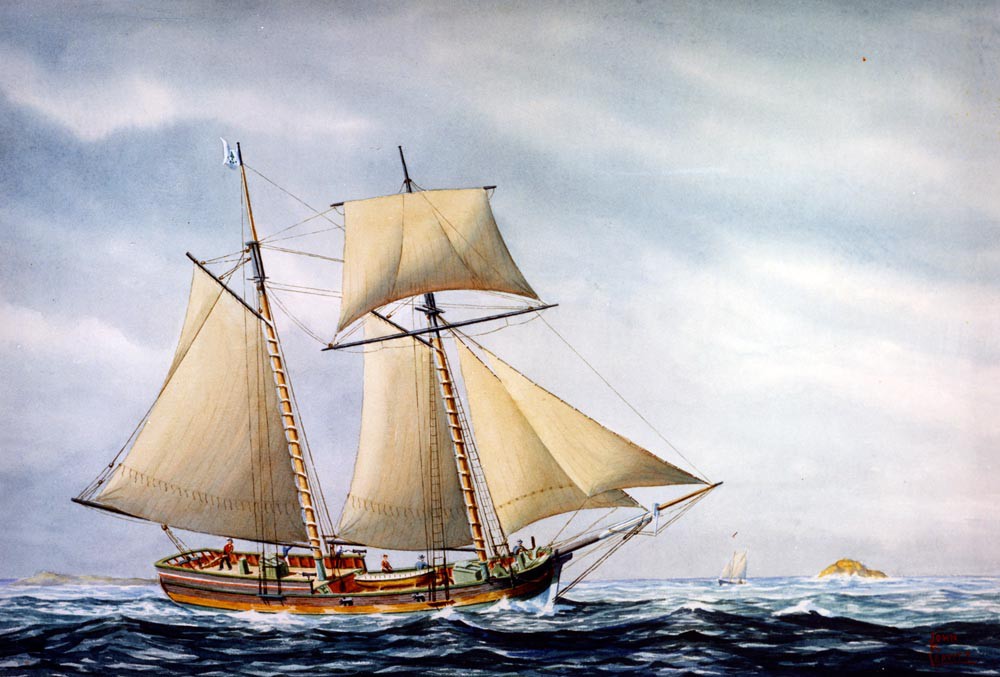
Image credit: National Museum of the United States Navy
Before there was a United States Navy, there was the Hannah, a modest fishing schooner turned warship that helped launch America’s fight for independence at sea. Commissioned in the fall of 1775 and fitted out in Beverly, Massachusetts, the Hannah holds a distinctive place in Revolutionary War history as the first armed naval vessel to sail under the authority of General George Washington.
The idea for the Hannah came at a time when the American colonies had no formal navy. The British Royal Navy controlled the Atlantic, blockading ports and threatening coastal towns. To counter this, Washington, then commander-in-chief of the Continental Army, authorized several small vessels to disrupt British supply lines. The Hannah, owned by merchant John Glover of Marblehead and manned by his experienced crew, was the first of these.
She set sail from Beverly Harbor on September 5, 1775, under the command of Captain Nicholson Broughton. Her mission was to intercept British supply ships along the coast. Though her career was brief, she was run aground by a British warship just a few weeks later. Hannah marked the beginning of organized naval resistance and set the stage for future naval operations.
While the Continental Navy would not be formally established until later that year, Hannah’s service demonstrated the value of maritime resistance and the strategic importance of local maritime communities, such as Beverly and Marblehead. Both towns later laid claim to being the “Birthplace of the American Navy,” and to this day, Massachusetts continues to celebrate its unique connection to that legacy.
Hannah’s legacy is a reminder that the fight for American independence was not confined to battlefields; it was also fought in shipyards, harbors, and on the open sea. In taking that first step toward naval warfare, Massachusetts played a central role in launching what would become one of the most powerful maritime forces in the world.