
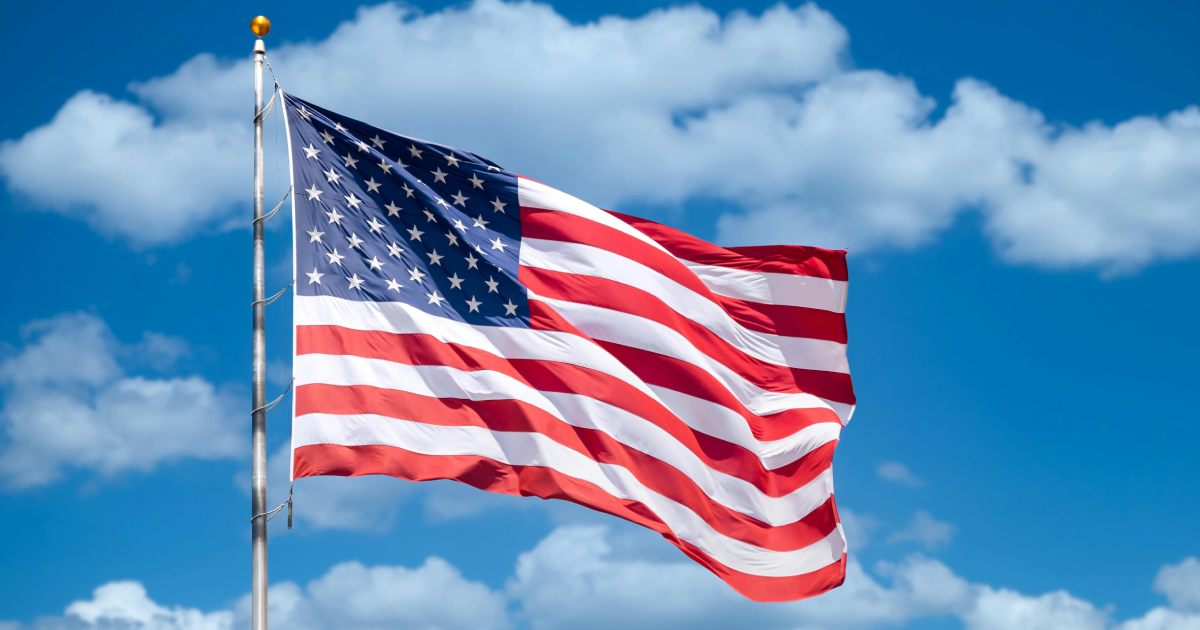
As America approaches its semiquincentennial, the American flag is more than a familiar symbol above schools, town halls, ships, cemeteries, and front porches. It is a living reminder of an unfinished promise.
The flag’s 13 stripes recall the original colonies, and its 50 stars represent the states joined in one Union. Its colors are often described as red for valor and bravery, white for purity and innocence, and blue for vigilance, perseverance, and justice. But at 250 years, the meaning of the flag is not found only in its design. It is found in the places where it flies, the people it gathers, and the questions it asks of each generation.
America250’s Flag Sojourn captures that meaning in motion. A single American flag is traveling to every U.S. state, every U.S. territory, and every U.S. military cemetery overseas before concluding in Washington, D.C. The National Flag Foundation describes the journey as a tribute to the nation, its citizens, and those who gave their lives in service to the ideals the flag represents.
When the flag comes to Massachusetts from June 12–17, 2026, it will arrive in a Commonwealth where the American Revolution is a living part of our identity, our communities, and who we are. It will fly at places that tell different chapters of the American story: the Bunker Hill Monument, commemorating the Revolution’s first major battle; the USS Constitution, a symbol of the young nation’s endurance at sea; Massachusetts National Cemetery in Bourne, where service and sacrifice are remembered; the Springfield Armory, tied to both the Revolution and American industrial innovation; Boston Harbor, where the story of resistance, independence, and self-government still echoes; the USS Massachusetts in Battle Ship Cove in Fall River, museum and WWII memorial; and the Mayflower in Plymouth, a 17th century English merchant ship.
The National Park Service notes that Bunker Hill commemorates the Revolution’s first major battle, and that the monument stands where Provincial forces built their redoubt before the fight. Springfield Armory began as a major arsenal under George Washington’s authority and later became the first national armory, manufacturing muskets beginning in 1794.
In Massachusetts, the flag’s journey reminds us that America was not born as a finished achievement. It was born as an act of courage, debate, sacrifice, imagination, and contradiction. The flag has flown over moments of triumph and moments of grief. It has been carried by service members, raised by schoolchildren, folded for families, waved at celebrations, and preserved in museums so future generations can ask what it means to belong to this country.
That is why the flag matters at 250. It is not simply a banner of the past. It is a call to citizenship. It asks us to remember those who came before, to honor those who served, to include more fully those whose stories were left out, and to carry forward the work of liberty, justice, and union.
As this flag travels across Massachusetts and then on to Washington, D.C., it carries with it a message worthy of the semiquincentennial: America’s story belongs to all of us, and the promise beneath the stars and stripes is ours to protect, renew, and pass on.