
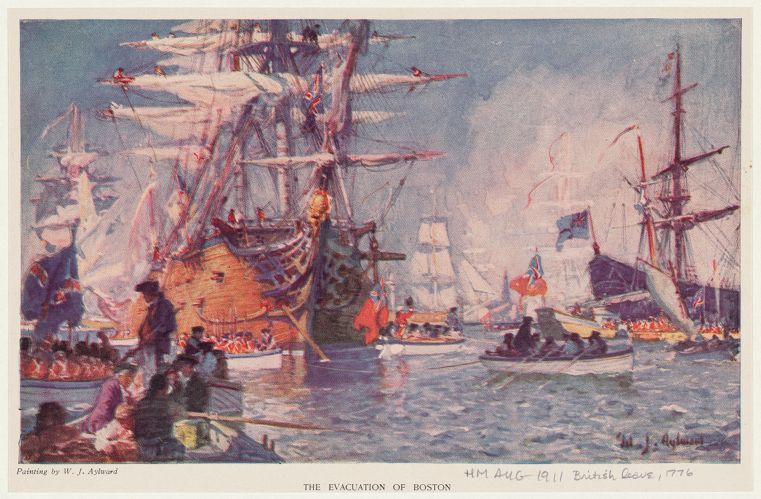
For many in Massachusetts, March 17 evokes more than just St. Patrick’s Day. It is Evacuation Day, a holiday that commemorates a pivotal moment in early American history, when British forces withdrew from Boston at the end of the Siege of Boston in 1776, marking George Washington’s first major strategic victory in the Revolutionary War.
After the Battles of Lexington and Concord ignited armed conflict in April 1775, colonial and British forces settled into a long siege. For more than eleven months, Boston’s residents and Continental Army troops faced sporadic skirmishes, hardship, and uncertainty. In March 1776, Washington ordered a bold move: fortify Dorchester Heights, the elevated ground overlooking Boston Harbor, with cannons that had been hauled hundreds of miles from Fort Ticonderoga by Henry Knox’s legendary “Noble Train of Artillery.”
On the morning of March 5, British commanders awoke to find heavy artillery looming over their positions. Rather than risk a bloody confrontation like Bunker Hill, British General William Howe chose to withdraw his 11,000 troops and loyalist families, departing Boston by sea on March 17, 1776. The evacuation effectively ended British occupation of the city and served as a morale-boosting first triumph for the Continental Army.
Locally observed since the early 20th century, Evacuation Day became a legal holiday in Suffolk County in 1901 and was formalized by state law in 1938. The day holds layered meaning in Boston, intersecting with St. Patrick’s Day parades and community celebrations, but it remains rooted in that decisive Revolutionary moment when Massachusetts helped lay the foundation for a new nation.
As part of Massachusetts 250, the 250th anniversary of Evacuation Day on March 17, 2026, carries special significance. More than simply revisiting an old story, this anniversary invites a statewide conversation about resilience, strategy, and community in the face of adversity, themes that resonate today as they did in 1776.
For 2026, Evacuation Day will serve as one of the signature commemorations within the statewide 250th anniversary observance. The March 17 anniversary will feature a series of public events that honor both the historical turning point and the community that shaped it. Plans include a memorial service at St. Augustine’s Chapel in South Boston, followed by a ceremonial procession to Dorchester Heights, where commemorative exercises at the Dorchester Heights Monument will bring together civic leaders, historians, reenactors, and residents in a shared moment of reflection and pride.
In the days leading up to March 17, visitors can engage with immersive public programming designed to bring 1776 to life. Special harbor cruises will retrace the route taken by British ships as they departed Boston, narrated by National Park Service Rangers who interpret the strategic and human dimensions of the evacuation. Additional events may include historical encampments, educational programming, and interpretive experiences that connect audiences directly to the landscape where the Revolution unfolded.
This 250th anniversary of Evacuation Day is an invitation to reconnect with the courage, ingenuity, and collaboration that defined this moment. It reminds us that independence was not inevitable. It was achieved through bold leadership, community sacrifice, and strategic brilliance. In 2026, Massachusetts will not only remember the day the British left Boston. It will honor the resilience and resolve that helped launch a nation.