
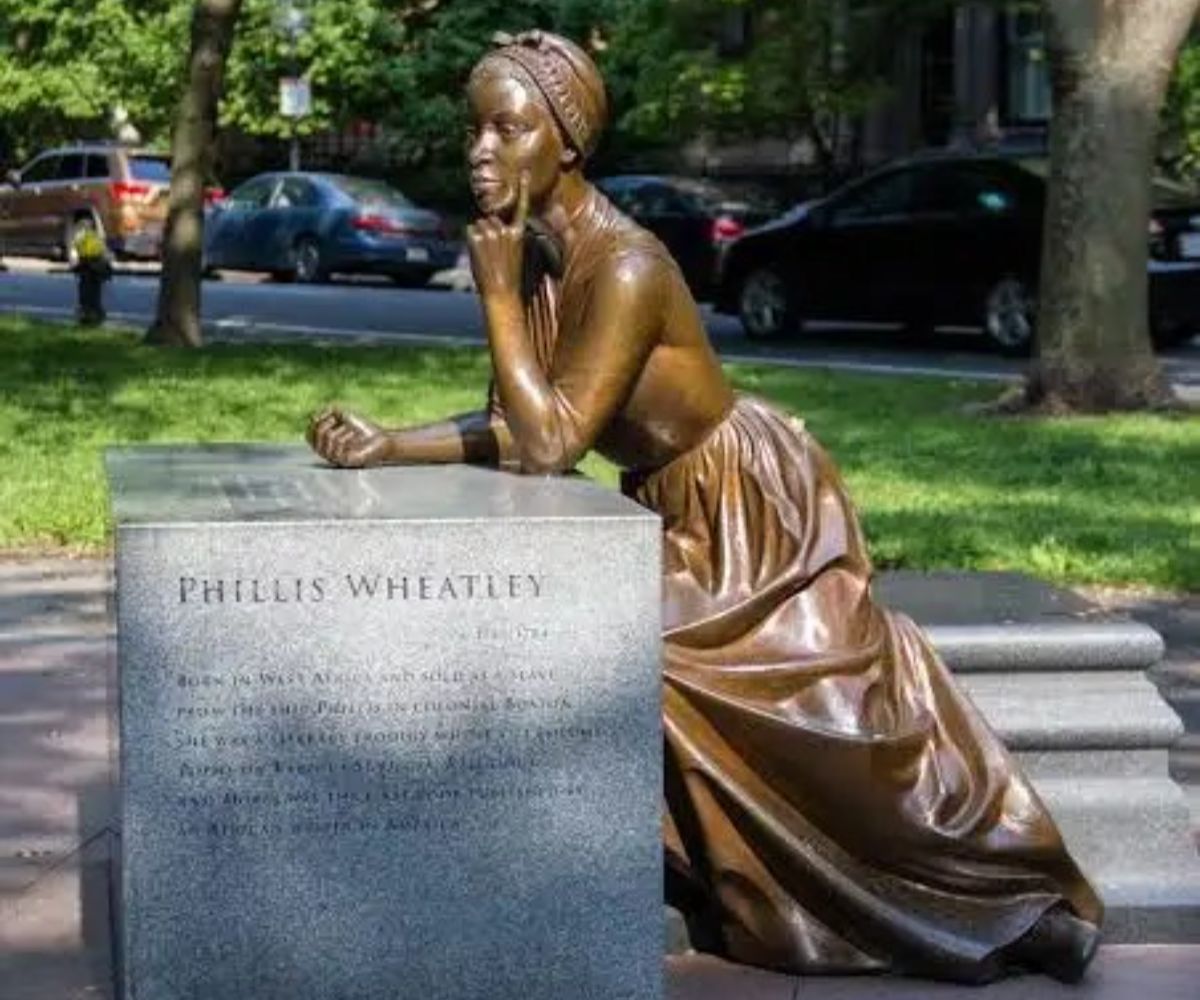
When the American colonies were still fighting for independence, a young enslaved woman in Boston was quietly making history with her pen. Phillis Wheatley, the first African American and one of the first women in America to publish a book of poetry, gave voice to the ideals of liberty and human dignity at a time when both were denied to her.
Born in West Africa around 1753, Phillis Wheatley was captured as a child and sold into slavery. She arrived in Boston in 1761 aboard a ship named the Phillis, from which she took her name. Purchased by John and Susanna Wheatley, she was brought into their household as a domestic servant.
Unlike most enslaved people, Phillis was taught to read and write by the Wheatley family. Her intelligence quickly became evident, and by her teenage years she was reading Greek and Latin classics, studying scripture, and writing verse. Boston’s intellectual elite marveled at her talent, though many doubted that an African woman could produce such sophisticated poetry.
In 1773, at just 20 years old, Wheatley’s collection Poems on Various Subjects, Religious and Moral was published in London, making her the first African American to publish a book of poetry. The volume included tributes to public figures, reflections on faith, and meditations on freedom. Her writing earned her international fame, with figures like Voltaire and Benjamin Franklin acknowledging her work.
Her poem “To His Excellency General Washington,” written in 1775, praised the Revolutionary cause and personified America as “Columbia,” a goddess of liberty. Washington himself invited Wheatley to visit him at his Cambridge headquarters, recognizing the extraordinary achievement of a young Black woman supporting the Revolution through verse.
Wheatley’s life embodied the contradictions of the Revolution. While patriots spoke passionately about freedom from tyranny, she remained enslaved for much of her life, ultimately gaining her freedom after the publication of her book. Her work often reflected on themes of liberty, redemption, and justice, echoing the Revolution’s rhetoric while underscoring its unfinished promises.
Today, visitors can explore her legacy in Boston, where she wrote and published her poetry, and in museums and historical societies across Massachusetts that highlight her life. Her story reminds us that one of the Revolution’s most enduring battles was for freedom, equality, and recognition.