
Yes, there will be people dressed in 18th-century garb, and yes, there will be reenactments of everything from the Boston Tea Party to the firing of a musket to reenact the “shot heard round the world.”
Even as organizations and communities prepare to celebrate the nation’s milestone birthday, Massachusetts is looking to explore its history beyond the conventional recounting of the founding of the United States and its role in the American Revolution. The Bay State is seeking to amplify unheard voices and highlight untold stories.
The search for these untold stories is one of the five themes for the celebration outlined in the state’s MA 250 Field Guide, created by the Special Commission on 250th Anniversary Celebration of the American Revolution. That commission is in charge of distributing state funds to support different projects and organizations commemorating the country’s semiquincentennial.
In Worcester County, a joint collaboration between the Worcester Black History Project and the Nipmuc Indian Development Corp. in Grafton was awarded $60,000 from the state. It was one of a few local organizations, including Discover Central Massachusetts, to be included in the round of funding announced in July.
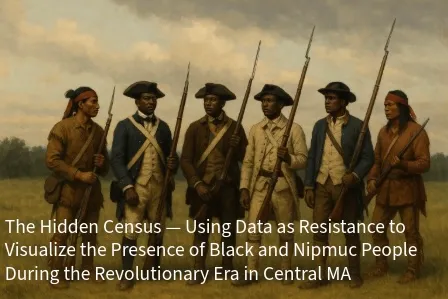
Even though the joint project title, “The Hidden Census: Using Data as Resistance to Visualize the Presence of Black and Nipmuc People During the Revolutionary Era in Central Massachusetts,” sounds daunting, its aim is to document the presence of both Indigenous people and people of color in Massachusetts at the time of the Revolutionary War and to record their roles in the conflict.
“We want to recover, reclaim the historical presence of Black and Nipmuc people,” said Cheryll Toney Holley, a professional genealogist and historian serving on the boards of both organizations. The Nipmuc ancestral lands extend through Worcester County and into parts of Connecticut and Rhode Island.
Toney Holley, a coordinator of the project, described it as an exercise in truth telling. It is a way, she said, to recover the voices and stories of the marginalized people of Central Massachusetts.
The team is searching for the stories that highlight the women, enslaved residents, newly freed people and the men who fought in the war in their owners’ steads to gain their freedom.
“We are uncovering stories people never hear about, stories that have been buried by the (current) way of teaching history,” Toney Holley said.
Still in the planning process, the tandem organizations have identified the artists and historians who will collaborate to create the project. This will include a traveling interactive exhibit that will visit libraries, schools, universities and other public places.
The group is also recruiting local high school and college students with native or Black ancestry who have a stake in finding the hidden stories. Historians will guide the students through finding and compiling data.
It was through similar research that Toney Holley found she had four separate ancestors who were participants in the Revolutionary War. Now she belongs to the Daughters of the American Revolution, not an association that she ever envisioned joining. However, Toney Holley noted, that organization is now inviting women of color.
The group anticipates finding numerous stories, and Toney Holley laments that it may not be possible to include all stories in the project. However, the organization will have the data and will be able to mine that database for future endeavors.
“This is the first time anyone has done this; it will be great,” Toney Holley said, explaining that the project will examine the history of documents used as tools of colonialism and racism. “We are bringing people forward, reclaiming the history and their presence and ancestry.”
Seeking new voices fulfills one of the state’s five visions of celebration listed in the booklet: the state’s many historic “firsts,” (first public school, printing press, university, public library, lighthouse, telephone, basketball game), its reputation for innovation and progress, culture and education, and community and diversity.
Discover Central Massachusetts, the tourism council that serves the city and 35 surrounding municipalities, has a different focus. It received $50,000 to complete its Revolutionary Firsts Trail, which highlights the region’s history and unique role in the American Revolution.
The project includes both printed and digital versions of a map of Revolutionary historic sites that is married with an audio guide that connects users to local stories and voices. The funding is also earmarked to support Worcester’s 2026 Independence Day Celebration, a free, family-friendly event projected to draw over 30,000 attendees.
The commission was established in 2021. Its primary goal is to develop and implement a comprehensive plan celebrating this milestone. It is also responsible for awarding grants; the first round of funding $1.5 million, was distributed in 2024, and a second round, $2 million, was announced in July.