
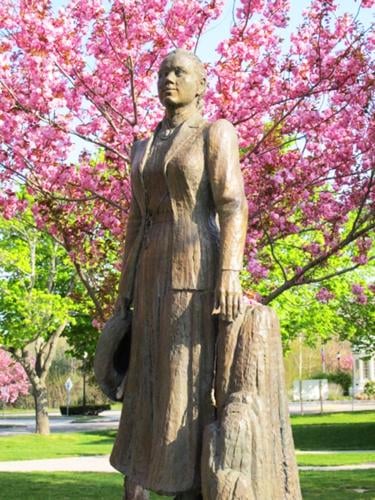
Lloyd Lillie created this statue of Katharine Lee Bates, which sits on the front lawn of the Falmouth Public Library. Photo credit: Salley Mavor
Katharine Lee Bates was born in Falmouth, Massachusetts, in 1859, and her deep New England roots helped shape one of America’s most enduring patriotic anthems, “America the Beautiful.” A poet, professor, and social advocate, Bates spent much of her life in Massachusetts, where her education, writing, and teaching intersected with the progressive spirit of the era.
Bates graduated from Wellesley College in 1880, a member of one of the school’s first graduating classes. She returned to Wellesley as a professor of English, where she taught for more than four decades. Her academic work focused on literature and writing, but her broader interests included social reform, women’s rights, and global peace. She was known for mentoring young women and encouraging them to pursue careers in education and public life.
The inspiration for America the Beautiful came in 1893 during a summer teaching trip to Colorado. After ascending Pikes Peak, Bates was struck by the vast landscapes of the American West and began drafting the poem that would become the hymn. When it was first published in 1895 in The Congregationalist, in Boston, her words quickly resonated across the country. Set later to music by Samuel A. Ward, the poem became a staple of national pride, revered for its imagery and ideals, calling not just for the celebration of natural beauty but for moral and civic righteousness.
Though she traveled widely, Bates always returned to Massachusetts. Her summers were spent in Cape Cod, and her academic year was spent at Wellesley. Her writings, ranging from poetry and essays to books on social issues, reflect a lifelong commitment to civic engagement and human dignity.
Katharine Lee Bates passed away in 1929, but her legacy endures in classrooms, songbooks, and historic markers throughout the state. Her words continue to inspire generations to see America not just as it is, but as it might aspire to be, “crowned with brotherhood from sea to shining sea.”